


What Is Performance Marketing?

Nathan Schenker
This is some text inside of a div block.

November 18, 2026
Performance marketing is a term that marketers coined in the early 2000s.
And even though all marketing is supposed to perform, the name stuck for a reason.
Instead of chasing less tangible outcomes like reach and awareness, it’s based on the idea that marketing spend should be measured, tied to sales and expected to earn back more than it costs.
And as digital advertising tools and platforms evolved over the years, performance marketing became the dominant approach to digital advertising.
But being able to measure results doesn’t necessarily make them easy to get.
Performance marketing strategies and tactics can’t simply run on autopilot. They involve research, targeting, copywriting, creative design, tracking, and constant testing. Each piece has to work with the others, and when one falls short, the whole campaign can start losing money, and often it can be hard to tell which piece is to blame.
In this guide, we’ll walk through how performance marketing works, piece by piece, so you know what it takes to build campaigns that pay for themselves.
What Is Performance Marketing?
Performance marketing is paid advertising that’s judged by one thing.
Does it bring back more money than it costs?
The term is tied so closely to paid advertising because paid ads can be tracked all the way to a result. When someone clicks your ad, the ad platform can record what they do next, whether they fill out a form, book a consultation, request a demo, or buy something directly from your website.
Since each result traces back to the ad behind it, performance marketing services have the ability to let you know what you paid for every lead and customer. Making every dollar accountable in a way most forms of marketing simply can’t. It also means that if an ad doesn’t earn back more than it cost you, you’ll know right away.
As a rule of thumb, you can run digital performance marketing campaigns on any channel where you pay for a trackable result.
But there are a few performance marketing channels most businesses tend to prefer:
- Google and Bing search ads
- Social ads on Facebook, Instagram, TikTok, Reddit, and YouTube
- Native ads, which blend into the articles and feeds people already read
In practice, the performance marketing platform you choose should reflect where your audience spends their time. If, for example, you’re a local plumber, it probably makes sense to run Google search ads rather than TikTok ads. As people with a burst pipe tend to search for help right away, rather than scrolling through Instagram.
This is why many businesses turn to a performance marketing company that can help them choose the right channels from the start.
How Does Performance Marketing Work?
Not long ago, a lot of online performance marketing rode on a hunch. Mainly, would a witty tagline or a funny video make people want to buy?
Today, any advertiser worth their salt treats their performance marketing strategy as a step-by-step process built on research and data. Every step has a job, and every dollar has to earn its place.
Paid Performance Marketing Always Starts With Buyer Research
Before writing a single ad in any of your performance marketing campaigns, you need to know who you’re talking to and what will make them act. That research usually works in layers:
- Your customers: who already buys from you and why they chose you
- Your audience: the wider group of people who could buy what you sell
- Niche personas: the smaller groups inside that audience, each with its own needs
For each group, you need to dig into what makes them tick. What’s their situation right now? What pains are they dealing with? What outcome do they want? And what objections might stop them from buying?
The answers to those questions will give you a map of your market, and show you who to target, what to say, and which offer will get them to act.
Build Ads Around an Offer
Performance marketing ads are built around something specific you want to sell, like a booked job, a demo, or a first purchase. They follow direct response principles, which means every ad asks the reader to take one clear action now.
The copy and creative come straight from your research, speaking to the pains, goals, and objections you uncovered. They also lean on angles and formats with a track record, from your own past campaigns or others in your industry. That way, you launch ads you already have good reason to believe will work.
Each ad then sends people to a landing page built for one job: turning that click into a lead or sale. If the page doesn’t match the promise in the ad, people leave.
Track, Cut and Scale
Once a campaign goes live, you need to track its digital marketing performance. Basically, which ads bring in leads and sales, and what each one costs you. From there, the work becomes a loop:
- Pause any ad that loses money
- Move that budget to the ads that bring back more than they cost
- Test new copy and creative against your winners
Each round makes the campaign more profitable. And once you can see that $1 in ad spend reliably brings back $3, the question becomes how much more you can put in while the returns hold. It’s also worth noting that this strategy applies universally to any performance marketing channel you use.
What Are the Main Types of Performance Marketing?
Every channel below lets you pay for a result you can track. What sets them apart, and decides whether they belong in your performance marketing plan, is how they align to where your customers are in their buying journey.
Some people don’t know they have a problem yet. Some know what they need and are comparing options. Others are ready to buy today.
Each group reaches one of these groups better than the others.
Search Ads
There are quite a few platforms in the world of search ads, but two typically get brought up more than most.
Google and Bing.
In the case of these ads, a person usually already has a need, so they tend to bring in buyers who are ready to act. They’re a strong fit for local service businesses and for businesses who are looking for a direct sale.
Social Ads
Facebook, Instagram, TikTok, Reddit, and YouTube let you target people by their interests, behaviour, and demographics. What’s interesting is that most people on these performance advertising platforms aren’t looking to buy. They’re often just relaxing and enjoying some downtime. So your ad has to stop the scroll and give them a reason to care.
Social media performance marketing is a good place to create demand, test new angles, and reach people around the topics and interests they enjoy during their personal time.
Shopping Ads
For eCommerce brands, Shopping ads show your product photo, price, and store name right in the search results. Shoppers know what they’re getting before they click, which cuts down on wasted clicks. These ads are predominantly for brands that offer products that suit a direct response style of ecommerce. Think clothing, beauty, or consumer staples.
Retargeting
Statistically, most people won’t buy on their first visit. So retargeting ads are shown to people who’ve already been to your site, viewed a product, or started a form. Since they already know you, these ads often bring back more than they cost.
Native Ads
Native ads blend into news sites and content feeds, so they read more like an article than an ad. They suit offers that need a little explaining before someone buys.
The big takeaway is that not every performance marketing channel is a perfect fit. So it’s best to start with the one where your buyers already spend their time.
How Do You Measure Performance Marketing?
You can only measure what you track.
That means your ads tracking has to be in place before your first ad goes live. Otherwise, you’re spending money you can’t trace back to a result. But once you do, there are a few performance marketing analytics and metrics that can determine if you're on the right path.
Conversion Tracking and Attribution
Conversion tracking records the actions you care about, like a form fill, a booked job, or a sale. Attribution ties each of those actions back to the ad that drove it.
If your business operates in a B2B setting, it’s worth connecting your ad platforms to your Customer Relationship Management (CRM) system. That way, you can see which leads became paying customers, not just which ones filled out a form.
Setting up your conversion tracking and understanding attribution can be complex, which is why many businesses choose to have an experienced performance marketing company handle it for them.
Cost Per Lead and Cost Per Acquisition
Cost per lead (CPL) is what you pay for each new inquiry. Cost per acquisition (CPA) is what you pay to win one customer. A low CPL means little if those leads never buy, so watch both.
Return on Ad Spend
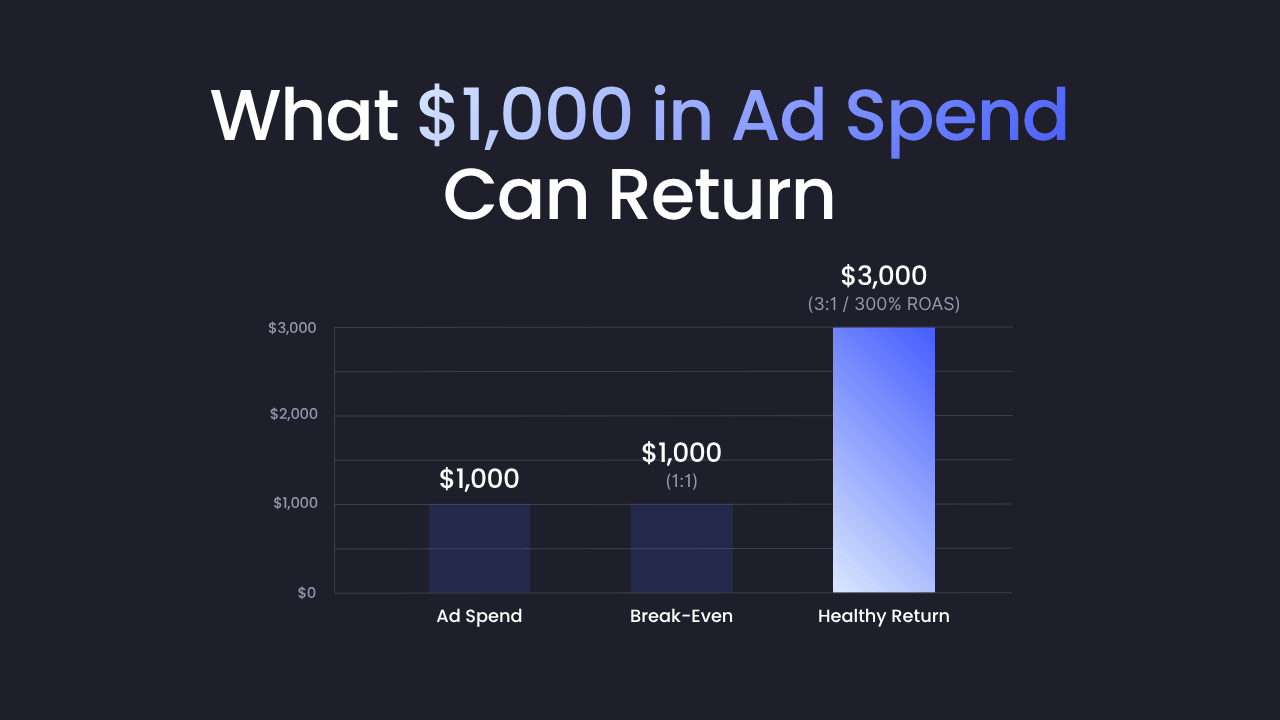
Return on ad spend (ROAS) shows how much revenue each ad dollar you spend brings back. If, for example, $1,000 in spend brings in $3,000 in sales, your ROAS is 300%.
Here at Hypelocal, we have a performance marketing example that shows how far that can go. For one online jewellery retailer, our performance marketing campaigns reached a 937% ROAS. That’s about $9.37 in sales for every $1 spent.
But as a general rule of thumb, a ROAS in the ballpark of 3:1 is totally acceptable.
Customer Lifetime Value
Customer lifetime value (LTV) is what a customer is worth over the whole relationship, not only their first purchase. So a $200 customer can be a bargain if they spend $2,000 with you over two years. Essentially, LTV tells you how much you can afford to pay to win each one.
These aren’t the only metrics you need to consider, but they’re a few that you’ll need to look at before you deliver your first campaign.
How Do the Costs Typically Break Down?
With most paid ad platforms, you don’t pay a fixed price for an ad spot. Instead, you bid for it in an auction.
Let’s use Google, one of the world’s biggest digital ad platforms, as an example.
Every time someone searches on Google, an auction runs in a split second. Meaning every advertiser targeting that search competes for the ad spot on the page.
But here’s where things get interesting.
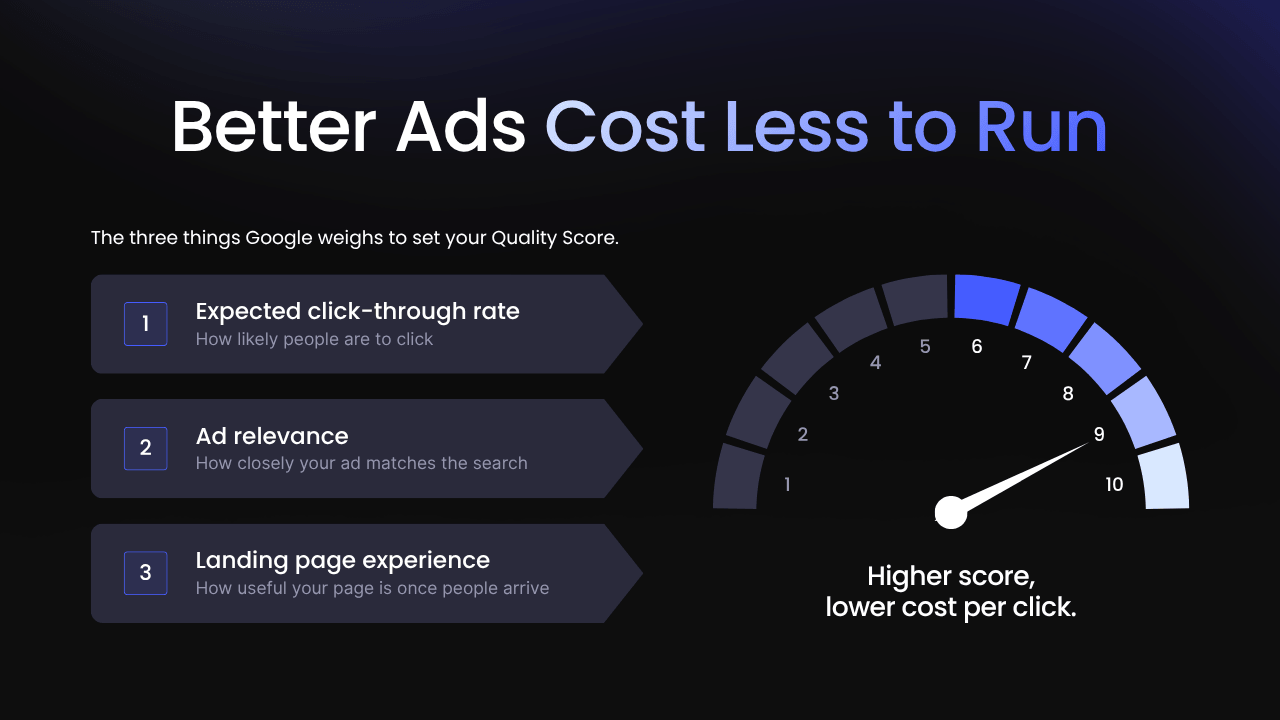
The highest bid doesn’t always win. That’s because Google also weighs the quality of each ad.
In particular, it looks at three things:
- Expected click-through rate: how likely people are to click your ad
- Ad relevance: how closely your ad matches the search
- Landing page experience: how useful your page is once people arrive
In your Google Ads account, these show up as a Quality Score from 1 to 10. Think of it as a report card Google’s handing out to you so you know if you're scoring steady A’s or averaging C’s.
Let’s use a simple example of two plumbers bidding on the search term “emergency plumber.”
- Plumber A bids $10 a click. Their ad matches the search and their page loads fast, so their quality rating is 8.
- Plumber B bids $15 a click. Their ad is generic, and their page is slow, so their rating is 4.
Multiply bid by quality, and Plumber A scores 80 while Plumber B scores 60. Which means Plumber A wins the top spot with the lower bid.
Plumber A also doesn’t pay the full $10. They pay just enough to beat Plumber B, which works out to about $7.50 a click.
Meta, Bing, and most other ad platforms run similar auctions. So regardless of where you advertise, a better ad and landing page usually means you pay less for every click, lead, and sale.
What Are the Benefits of Performance Marketing?
Performance marketing gives you proof, plain and simple.
It offers a level of insight, detail, and accountability that most forms of marketing can’t compete with.
But those aren’t the only benefits. Below, we’ve put together the ones our own clients bring up most often.
Your Budget Follows What Works
Every lead and sale traces back to an ad, so you never have to guess where your money should go.
Losing ads get paused.
Winning ads get more budget. And over time, your spend shifts toward whatever earns the most.
Lower Risk From Day One
You don’t need a huge budget to start with performance marketing.
You can test an offer with a small spend, check the numbers, and only then decide to scale.
If something isn’t working, you can find out early, before it gets expensive.
Clear Answers for Better Decisions
Many businesses can’t tell which parts of their marketing are working.
Performance marketing isn’t usually one of them. Everything is tracked, accounted for, and tied back to measurable results. Making budget calls a lot easier.
Faster Launches and More Testing with AI
This one’s a new benefit, but still extremely valuable. AI tools can now help you draft ad variations and pull reports in a fraction of the time.
And with AI-assisted workflows, campaigns can go live in days, not months, allowing you to test angles and approaches in a way (and at a cost) no one thought possible just a few years ago.
But speed only helps if quality holds.
The best setup has people setting the strategy and giving AI the right context. AI does the heavy lifting. Then a person reviews the work and signs off before any ad goes live.
Your ads speak for your brand, and one sloppy AI-written line can cost more trust than the time it saved.
Every Campaign Makes the Next One Smarter
This is the one performance marketers appreciate the most. Each campaign you create shows you which approaches and methods get clicks, which offers convert, and arguably the most important one of them all, which objections are stalling a potential sale.
What Are the Drawbacks of Performance-Based Marketing?
Okay, we’ve spent quite a bit of time talking about the benefits of performance marketing.
But are there any drawbacks?
Unfortunately, yes. In fact, there are three major ones, and in most cases they’re the reason businesses bring in a specialist or agency.
Clicks Can Get Expensive
In most cases, paid ad auctions get tougher as more businesses bid on the same buyers.
A weak ad or slow landing page raises what you pay for every click. Which means small budgets can run out before you have enough time to collect data and develop a strategy.
Tracking Has Gaps
Privacy rules, ad blockers, and people switching between phone and laptop all break the trail from ad to sale.
This is especially true for conversions that require long sales cycles. And when these gaps appear, it can be extremely difficult to reconnect the dots.
It Needs Steady, Balanced Attention
Ads wear out as people see them again and again.
So campaigns need fresh approaches, ongoing testing, and someone watching the numbers weekly.
And even when campaigns work, leads can pile up faster than your team can follow up. A trained specialist understands how to find the balance between creating a steady stream of sales, leads, and business without overloading what your operations can handle.
Is Performance Marketing Right For Your Business?
A lot of businesses aren’t sure if they’re a good fit for performance marketing. And if you’re new to the space, that’s completely understandable.
So here’s the truth: if your business already has something that sells, it’s probably a good fit for performance marketing.
Here’s why.
Performance marketing amplifies what’s working. It takes an offer people already buy and puts it in front of more of the right people. If customers already choose you, come back for more, or send their friends your way, ads help you reach more people just like them.

Taking The Next Step
The best way to approach performance marketing is to treat it as an investment.
Like any good investment, it needs time and steady attention. Your first few weeks are about gathering data, so a slow start isn’t a reason to quit. From there, you cut what loses money, move budget to what earns, and keep testing new ideas.
Each campaign teaches you more about your buyers, which makes the next one more profitable. Over time, those lessons add up, and your ad spend starts working harder for you.
Getting that right takes experience, and that’s where Hypelocal can help. We build full-funnel Demand Generation Marketing systems that bring in the right buyers and show you exactly how your marketing drives sales. We’ve helped clients generate more than $600 million in revenue, and we back our work with an 8-week money-back guarantee.
Want to see where your marketing could do more? Book a free Strategy Session with our team, and we’ll show how performance marketing can work for you.

You may also like

Demand Generation Marketing
July 17, 2025
7 Essential Steps to Optimize Product Marketing for Better Conversions
Audit your product marketing in 7 steps to boost alignment, messaging, and lead quality for better conversions.

Search Engine Marketing
June 21, 2022
Google Ads Audit 101: An Easy and Effective Checklist to Download
Increase ad performance with a Google Ads Audit. Use this easy checklist to optimize campaigns, identify gaps, and capture consumer attention effectively.
Get in Touch


