


7 Legal Services Automations That Cut Costs and Create More Billable Work

Aaron LeBlanc
This is some text inside of a div block.

September 4, 2026

It's 4:47 on a Tuesday, and a new inquiry from a serious personal injury claimant just landed on your firm's contact form.
Normally, it would be handled by a junior paralegal, but today they're wrapping up a consultation, and by tomorrow, that six-figure case will likely be signed with another firm.
Most firms see this happen and assume the answer is hiring another paralegal. But the firm isn't short on demand, it's short on capacity. Every case carries hours of manual work no lawyer should be doing, and until those manual processes change, every new hire just absorbs the same backlog.
That's why more firms are turning to legal automation powered by artificial intelligence, not to replace legal judgment, but to remove the repetitive tasks around it. AI automation takes the load off intake, follow-up, and reporting, so leads get responses in minutes, attorneys get freed from administrative work, and the firm absorbs more cases without adding headcount.
For legal teams and legal professionals across the legal industry, the highest-impact opportunities in legal workflow automation come down to seven workflows. In this article, we'll walk through each one, what it solves, and what your legal practice looks like once it's in place.
.png)
Why Your Team Is Busy But Your Profitability Isn't Growing
Every missed lead has a price, but it's not the only one your firm is paying. Most firms don't lose time to inefficient legal work. They lose it to the manual processes around that work. The same legal processes slowing intake run in the background of every active matter, pulling attorneys and paralegals into time consuming tasks that have nothing to do with practicing law.
- $120,000 a year in lost billable capacity when a senior associate billing $400/hr spends six hours a week on admin
- The same case details entered three times across intake forms, CRMs, and case management systems which is a recipe for human error
- No real-time view of what's closed or where the team is stretched until someone rebuilds a report by hand
Each of these is a handoff someone does by hand, and every handoff is a chance for time, context, or revenue to slip through. The administrative burden builds quietly, and the more lawyers spend on it, the less time is left for billable work. It doesn't take long to see why hiring can't fix this, because the problem isn't the number of people. It's the process, and for most firms, real operational efficiencies start with seven specific automations.
1. Lead-to-close Automation Software
Think of Lead-to-close automations as an intake coordinator that never sleeps. No matter where an inquiry comes from, a web form, an email, a paid ad, or a referral, it gets captured in one place and checked against your existing systems so nothing's entered twice.
From there it's qualified against your firm's criteria, routed to the right attorney by practice area and availability, and booked into the calendar without anyone touching it. This kind of process automation turns a scattered intake into one clean, trackable path.
For firms still running intake through a shared inbox, the difference shows up immediately. Leads that used to wait hours get a response in minutes, and the attorney walking into the consult already has the context to make it count. Clean data capture at the first touch means no one is retyping details later. And when an inquiry isn't a fit, it doesn't vanish into an inbox. It's routed to a nurture sequence or pointed to the right resource, so nothing gets dropped.
Sensitive client information stays inside systems your firm administers, role-based permissions decide who sees what, and every interaction is logged, so there's a clean audit trail from first touch to signed matter management.
2. AI-Powered Intelligent Chatbots
People search for legal help in the hours after something goes wrong, not between 9 and 5. By the time your office opens, they've already had a conversation with a firm that was available when they needed one.
An intelligent chatbot trained on your firm's practice areas, FAQs, and intake criteria handles those conversations around the clock. Built on AI-powered tools, it answers questions within the scope you define, classifies the inquiry by practice area, collects case details up front, and books the consult directly into the right attorney's calendar.
For clients, this is offering self service options at the exact moment they need them — the same self service tools that let a prospect get answers and book a consult without waiting for business hours. Self service options like these lift client satisfaction and meet rising client expectations for instant response.
Done correctly, this automation is more than a generic chat widget with scripted responses, it's a system that qualifies leads the way your team would and hands off a warm, documented prospect by the time anyone arrives Monday morning. Everything it gathers stays inside your systems, with no third-party tools handling sensitive client information along the way.
3. System Integration and Data Sync Automations
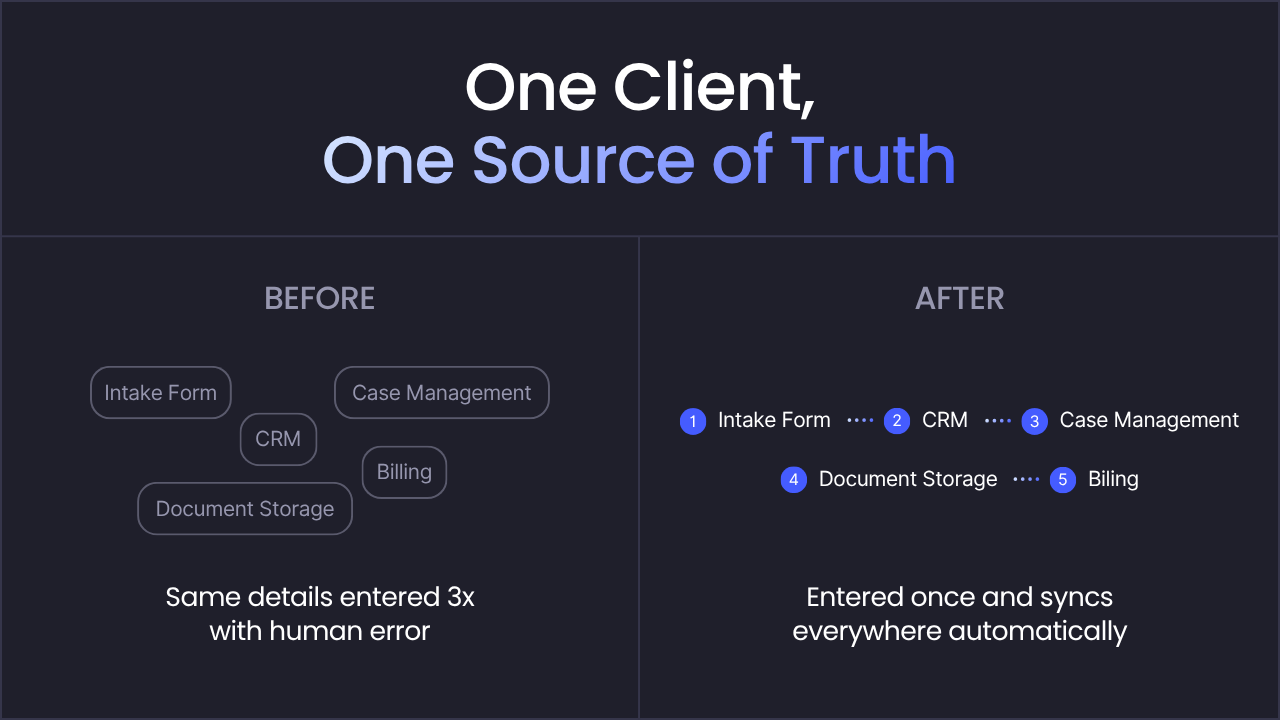
Running a law firm on fragmented systems is like having five employees who never talk to each other but are all responsible for the same file.
- The intake form lives on the website
- The CRM tracks prospects
- Case management handles active matters
- Document storage holds the signed files
- Billing runs separately
And somewhere in between, a paralegal is entering the same case details three times, and that's where human error compounds and confidentiality risks quietly grow.
System integration and data sync automations connect those platforms so information flows automatically from a single source of truth, and intake, documentation, follow-up, and reporting stop depending on manual handoffs. Streamlining processes this way helps you mitigate risk at exactly the points where data used to get duplicated or dropped.
A new client enters the CRM once and appears in case management with the correct matter type, billing rate, and assigned attorney already populated. The data stays consistent, the audit trail stays clean, and your team gets Wednesday mornings back.
4. Email Automations
Client communication runs on a predictable rhythm. Intake confirmations, requests for legal documents, status updates, appointment reminders. Every matter needs them, and at most firms, every one of these routine tasks gets written manually.
Service delivery ends up depending on which paralegal handles the file. The clients with the most attentive one stay informed. Everyone else gets less, not because anyone meant for that to happen, but because the team only has so many hours.
Email automation takes the writing off your team's plate. When a matter hits a milestone, the right email gets sent automatically, personalized to the client and the case. Whether it's a "we've received your documents" confirmation or a reminder to sign the retainer, sensitive information goes through secure portals instead of a standard inbox, and every message remains compliant. Streamlining repetitive communication like this protects client satisfaction across every file, not just the well-staffed ones.
5. Automated Reporting and Dashboards
Most partners are making decisions about hiring, marketing spend, and capacity based on a spreadsheet someone pulled together last Friday. So it's no surprise that by Monday's meeting, it's already outdated.
Automated reporting and dashboards pull real-time data from the existing systems your team already uses, including intake forms, the CRM, case management, calendars, and billing, and present it in one place. Instead of manual reporting, AI platforms and automation software surface the numbers live, so no one rebuilds a report by hand and no figure on the screen is a week old.
In seconds, leadership can see which sources are producing signed matters, so marketing spend follows what actually converts. They can see open matters by attorney and where work is piling up, so capacity and hiring decisions run on real load instead of a hunch. That's measurable value leadership can act on, and it's a direct path to improving efficiency across the firm.
6. AI-Powered Writing
Every attorney knows the feeling of staring at a routine client letter that should take five minutes but keeps getting pushed to the end of the day.
First drafts of correspondence, summaries that pull a long email thread down to what matters, intake notes that capture what a prospect really said. None of it requires legal judgment to write, but all of it requires a lawyer's time to produce, and every hour spent on it is an hour that can't be billed.
An AI-powered automation handles document generation using your firm's document templates, voice, and matter context, so document drafting for standard correspondence is 80% done before an attorney touches it, and a lawyer still reviews and approves before anything reaches a client. The AI system handles the typing, your attorneys handle the thinking, and your team is freed for strategic work. A letter that used to take twenty minutes now takes three, which is how firms scale efficiently without adding people.
7. Intuitive AI Agents
Picture an associate who never forgets a follow-up, never misses a deadline, and never lets a case go cold. Now picture that level of attention on every active matter at once. That's what an AI agent does, and it's where deadline tracking stops depending on anyone's memory.
Agents handle the multi-step work that's too complex for a simple automation but too repetitive to keep handing to a person. These are exactly the repeatable processes — collecting documents across a string of follow-ups, checking in between milestones, keeping a matter moving — that drain hours without needing legal skill.
Here's what that looks like in practice. After a consultation, an agent writes up a structured matter management note, identifies the follow-up tasks, and assigns each one to the right attorney or paralegal. Because these AI systems run on your firm's instructions and knowledge, agents work across every matter at the same time, with every action logged and every decision open to review.
.png)
What Your Firm Looks Like When Operations Stop Getting in the Way
Picking the right automations is one thing. Installing them in a working firm without disrupting active matters is another. That's the part we handle.
At Hypelocal we map the existing systems your firm already runs on, from your CRM and case-management platform to document storage, calendar, e-signature, and billing. We find where manual handoffs are quietly costing you capacity, then design a clear automation strategy and build it alongside your team, from the first blueprint through ongoing optimization.
Every workflow is built around how your legal team operates. Our legal expertise goes into legal automation systems, legal automation tools, and legal automation software that fit your stack, so legal operations automation supports the way you already work instead of fighting it. Sensitive client information stays inside systems your firm administers, attorney review stays in control of anything touching legal substance, and every action is logged.
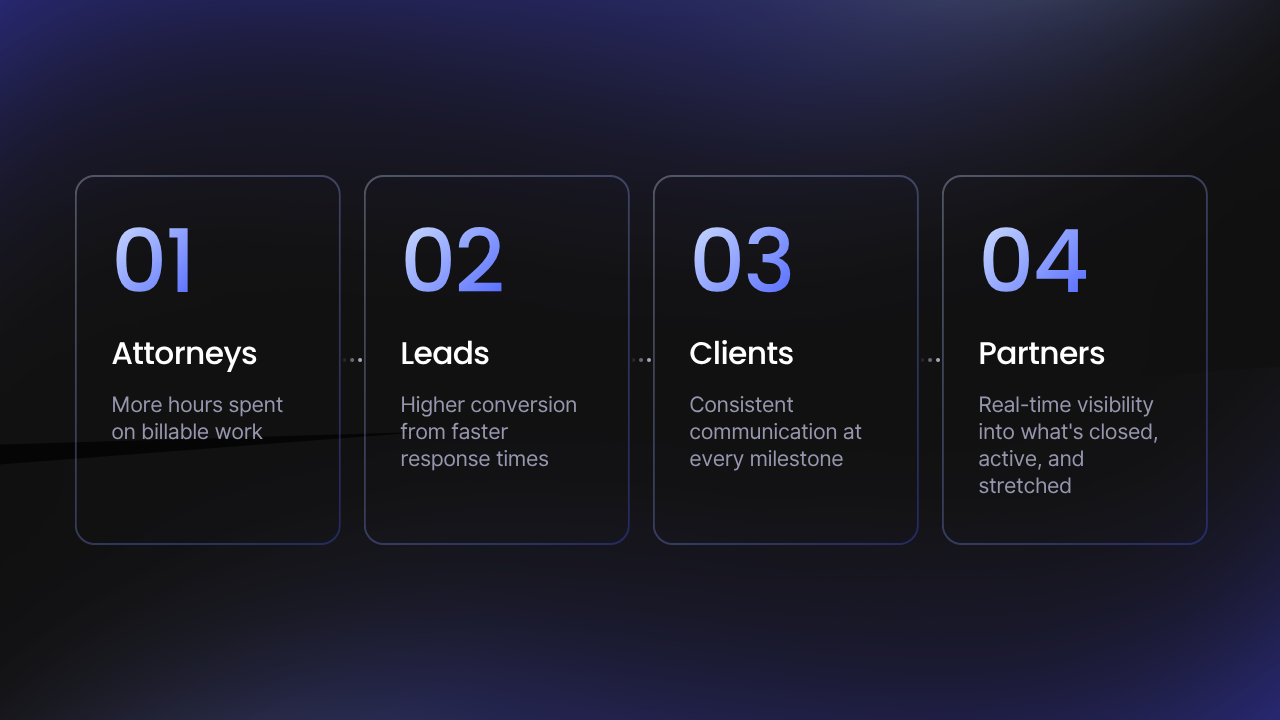
The key benefits are simple: lower costs, faster response, and more billable capacity. As a Certified Zapier Solution Partner, accredited by the Better Business Bureau, we've delivered thousands of automations that have saved hundreds of thousands of hours across every industry imaginable.
Why the Most Efficient Law Firms Already Have an Automation Strategy
The firms signing more cases this year aren't the ones that hired faster. They're the ones that stopped letting manual work decide how much they could grow. Across the legal landscape, the legal field is splitting into firms that automate the busywork and firms that keep absorbing it, and the efficiency gains compound for whoever moves first.
That's what we build at Hypelocal. Every system is tailored to your firm, with the compliance, security, and human-in-the-loop checkpoints that legal operations require.
If your firm keeps hitting the same ceiling no matter how many people you hire, book a free Automation Roadmap Session. In 30 minutes, you'll walk away with a clear picture of where manual work is capping your capacity and a blueprint for fixing it, whether you work with us or not.

You may also like
AI Marketing
June 3, 2025
5 AI-Powered Iteration Habits to Increase Conversions
AI-powered iteration speeds up marketing insights, testing, and optimization, making continuous improvement easier than ever.

Demand Generation Marketing
May 28, 2025
Why Hiring a Marketing Agency is Better Than Building an In-House Team
Agencies offer deeper expertise and lower costs than in-house teams, delivering better ROI and faster business growth.
Get in Touch


