


How Hypelocal Cut Cost Per Lead by 80% for a Saskatchewan Roofing Company
No items found.

July 6, 2026

A Saskatchewan roofing company had five years in business, a seasoned crew, manufacturer certifications, and a five-year workmanship warranty. Their META ads talked about all of it.
What the ads never addressed was the pricing conversation happening around them, where the majority of competitors in the same feed were leading with discount offers and per-square-foot rates.
Instead, their ads led with benefits and offers: fast turnaround times, thousands of happy customers, tips for evaluating quotes. None of it was wrong, but none of it explained the gap between this company's pricing and the discount hooks filling the rest of the feed.
The initial campaign results reflected that disconnect: $506.78 per lead.
Hypelocal rebuilt the creative strategy around directly addressing the pricing conversation instead of talking past it, and by the end of a six-week experiment, cost per lead dropped to $99.36.
This article will show you how we used an "Anti-Ad" creative strategy to generate an 80% decrease in cost per lead.
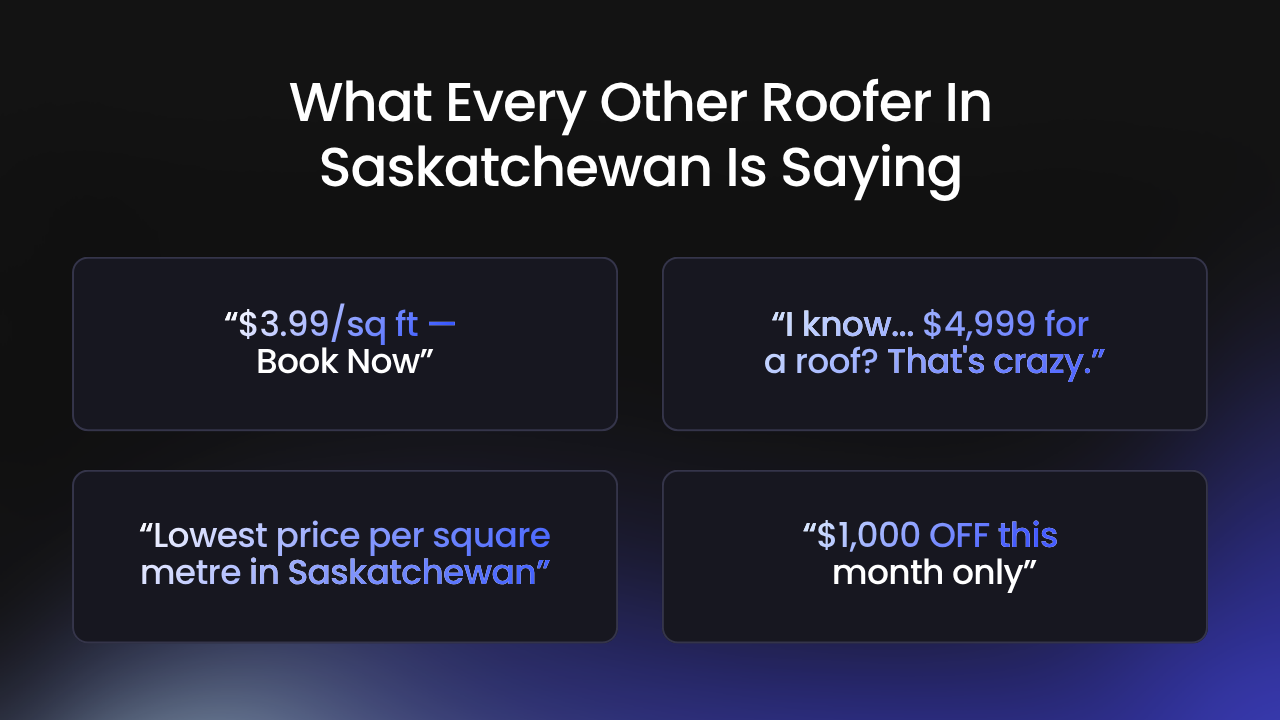
META's algorithm optimizes for engagement patterns, not business credentials.
It looks at the creative, identifies what the rest of the category looks like, and serves the ad to the type of audience that engages with similar content:
- "$3.99/sq ft"
- "$1,000 off this month"
- "Lowest price per square metre in Saskatchewan."
That price-first messaging was shaping what homeowners expected to see when a roofing ad appeared in their feed.
The client's ads weren't making the same claims. They were running benefit-led creative about speed, customer satisfaction, and what to look for in a quote.
That's reasonable messaging for a quality-first contractor, but it left a disconnect in the minds of prospects. Homeowners seeing those ads in the same feed as aggressive discount offers had no way to understand why one company's service costs more than another's.
That disconnect compounds over time. When a homeowner sees a price-driven ad and then a benefit-driven ad with no pricing context, the benefit ad has to work harder to justify attention.
The homeowner either assumes the prices are comparable, in which case the benefits feel like table stakes, or they assume the company without a price hook is the more expensive option with no clear reason to be.
Either way, the ad generates fewer conversions than it should because it's not addressing the context the competitive landscape has already created.
At $506.78 per lead, the client's campaign was showing every sign of that dynamic.
What a Full Competitor Audit Revealed
Before writing a single line of new copy, Hypelocal audited what every roofing company in Saskatchewan was running on META.
The goal was to understand what the category looked like from a homeowner's perspective and to identify whether the competitive landscape was contributing to the client's high cost per lead.
The audit confirmed what the numbers had been suggesting.
The majority of competitors were leading with some version of a price hook, whether that was a per-square-foot rate, a seasonal discount, or a lowest-price claim. Not every competitor was doing this, but enough of them were that price-driven creative had become the dominant pattern in the category.
That finding reframed the problem. The client's conventional ads weren't failing because of weak copy or poor targeting. They were failing to engage with the pricing conversation that the rest of the market had already started.
Homeowners scrolling through roofing ads in Saskatchewan were seeing price after price after price, and the client's ads offered no response to that framing.
The strategic question became: instead of continuing to talk around the price conversation, what happens if you address it head-on and turn the company's higher price point into the reason a homeowner should choose them?
What Is An ‘Anti-Ad’?
An Anti-Ad is a creative format that admits something most companies would hide, then pivots to show why that thing is actually a strength.
The structure follows three steps: state the supposed flaw openly, reframe it as a feature, and then back the claim up with proof so the admission lands as credibility rather than weakness.
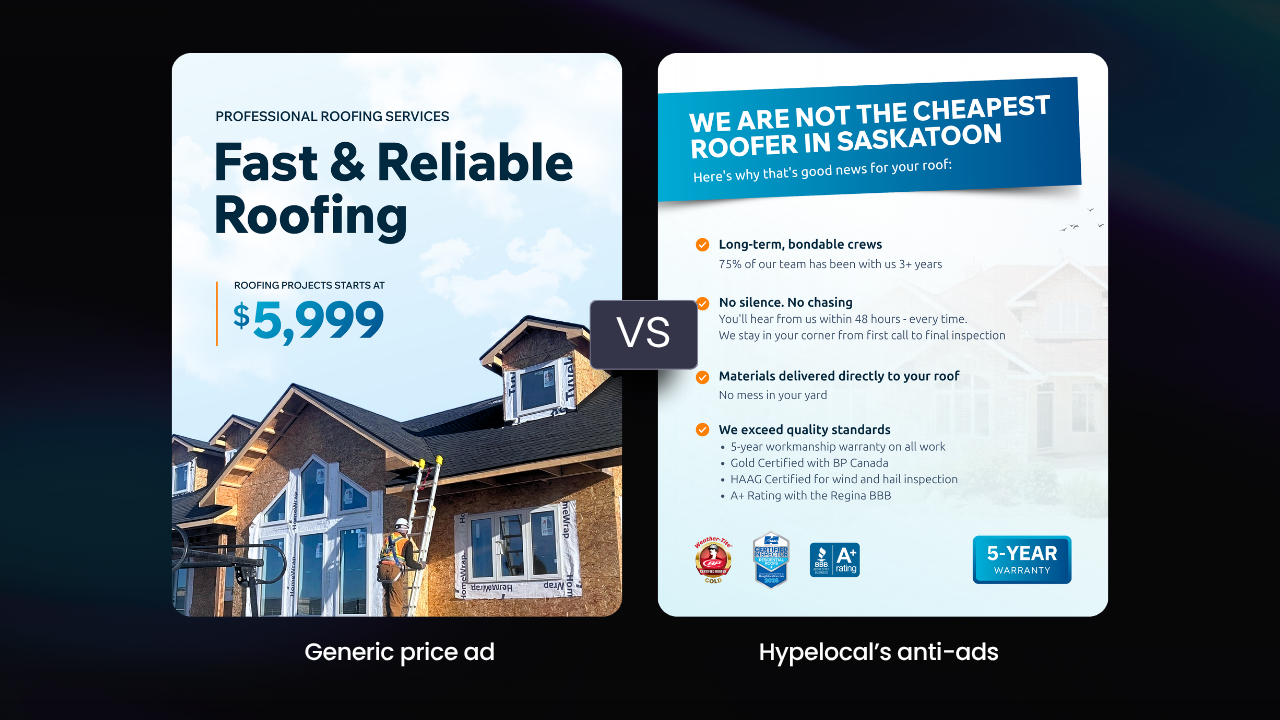
Hypelocal built two Anti-Ad creatives for this campaign.
The first opened with a plain statement: "We are not the cheapest roofer in Saskatoon." Then it explained why that's a good thing for the homeowner's roof, pointing to crew stability, fixed pricing, manufacturer certifications, and a five-year workmanship warranty.
The ad gave homeowners who already valued those things a specific reason to click, because it told them up front that this company charges more and showed exactly what that money pays for.
The second ad went further, telling homeowners directly that the company could use cheaper materials and pocket the difference, but deliberately chooses not to.
It named the premium materials and the quality standards behind the decision, and in doing so it helped homeowners understand what those lower-priced competitors might actually be cutting to offer their discounts. It defined what the business stands for and what the cheaper alternative actually means, all before the first conversation ever happened.
The hypothesis behind both creatives was that they would attract higher-intent homeowners who see the honesty and self-select into the funnel already understanding the pricing reality.
A homeowner who clicks on an ad that opens with "we're not the cheapest roofer" has already resolved the biggest pricing objection before they reach the landing page. They're not casually browsing. They're qualifying themselves.
The Six-Week Experiment
The test ran in three phases, structured specifically to isolate the creative variable so the results could be attributed to the Anti-Ad approach rather than seasonal shifts or audience changes.
Diagnostic Period
The diagnostic period ran from April 20 through May 4 and established the starting point: five leads at $506.78 per lead. That result confirmed the problem and triggered the full competitor audit, which led directly to the Anti-Ad creative development.
Control Period
The control period ran from May 4 through May 24 using optimized conventional ads only, with no Anti-Ad creative in rotation. It produced five leads at $265.79 per lead, and that number became the true baseline for measuring the Anti-Ads. Running both creative approaches simultaneously from the start would have made it impossible to isolate what the new approach was actually doing, so the control period existed to give the experiment a clean point of comparison.
Anti-Ad Period
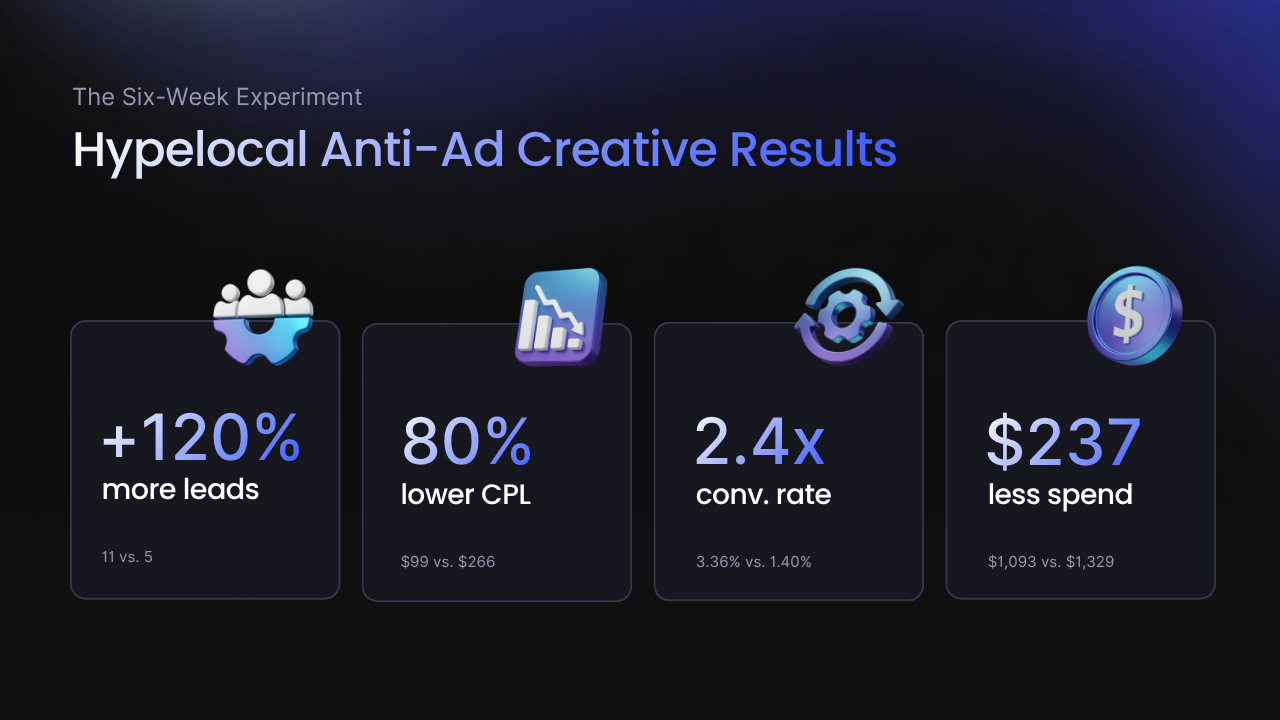
The Anti-Ad test ran from May 25 through June 14 with both approaches running head-to-head against the same audience at comparable spend levels. The Anti-Ads produced 11 leads at $99.36 per lead.
Spend dropped from $1,329 to $1,093 while lead volume more than doubled. Impressions were near-identical at 95,712 versus 92,242, and CTR barely moved at 0.37% for conventional ads against 0.35% for Anti-Ads. The metric that changed was conversion rate, which went from 1.40% to 3.36%.
Every one of the 11 conversions during the test period came from one of the two Anti-Ad creatives. The conventional ads running alongside them produced zero conversions during the same window. The result was statistically significant at 90% confidence with a Z-score of 1.69.
What CTR Didn't Tell Us, and What Conversion Rate Did
The CTR result was a pleasant surprise.
Hypelocal's hypothesis expected Anti-Ads to stop the scroll more effectively and generate a higher click-through rate, but the difference was only marginal.
The impact was in who the ads attracted.
Conventional ads brought broad interest from homeowners who hadn't been given a reason to think about price one way or the other. Anti-Ads attracted a far more committed audience of homeowners who had already processed the pricing reality before they ever reached the landing page. They clicked knowing this company isn't the cheapest, and they clicked anyway because the ad gave them a reason to.
That's why conversion rate more than doubled while CTR remained nearly the same. The landing page was doing less heavy lifting because the ad had already handled the pricing objection that kills most roofing sales conversations before they get started.
For contractors who are still measuring campaign success by click volume, this is the finding that matters most: More clicks from an audience that hasn't been pre-qualified on price doesn't improve performance. It's a more expensive way to fill a pipeline with leads that stall at the quote stage.
What Happens When Ads Address The Right Question?
Hypelocal didn't cut cost per lead by increasing the roofing contractor's budget or narrowing their audience targeting. We cut it by changing what the ads were saying.
The conventional creative was talking about the service. The Anti-Ads addressed the conversation happening in the market, explaining why this company costs more and why that's better for the homeowner.
If your competitors are leading with price and your ads don't explain why you charge more, the homeowner only hears one side of the conversation.
Changing your targeting or increasing your budget won't fix that. Changing what your ads say will.
Book a free strategy session with Hypelocal to find out what that could look like in your market.

You may also like
.png)
Email Marketing
October 5, 2026
The 2026 Guide to Email Marketing Automation
Email marketing automation solves a problem every business eventually runs into.Staying in touch with every customer at the right moment.For years, businesses handled email by hand, which led to late follow-ups, generic messages, and countless hours lost to manual work.

Paid Advertising
February 13, 2025
What is a Unique Mechanism—And Why Do Your Ads Need It?
A unique mechanism sets your ads apart by explaining how your product delivers results differently. It builds trust, credibility, and differentiation—helping you stand out in saturated markets and drive real conversions.
Get in Touch

